Two Humidifiers at Very Different Price Points — I Ran Both for Two Weeks
Miami isn't a humidifier city for most of the year, but when the AC runs hard in winter and pulls indoor humidity into the 30s, my sinuses notice. I've tested over a dozen humidifiers, but this head-to-head was inspired by a question a reader sent me: "Is the $150 humidifier really three times better than the $40 one, or am I just paying for a touchscreen?"
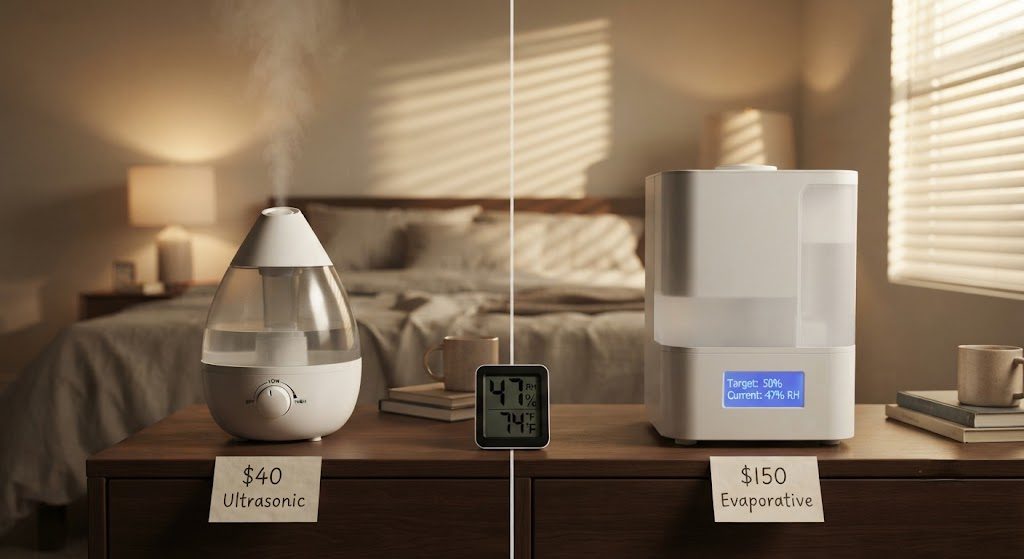
Fair question. So I grabbed two popular models — a no-frills $40 ultrasonic unit and a feature-rich $150 evaporative model — and ran them on alternating nights in my bedroom. Same room. Same starting humidity. Same AC settings. Two weeks of data.
The $40 Ultrasonic: Loud When It Counts
The budget unit was compact, lightweight, and dead simple: a dial knob, a small tank, and an ultrasonic plate that produced a visible plume of cool mist. On paper, it covers up to 250 square feet, which more than handles my bedroom.
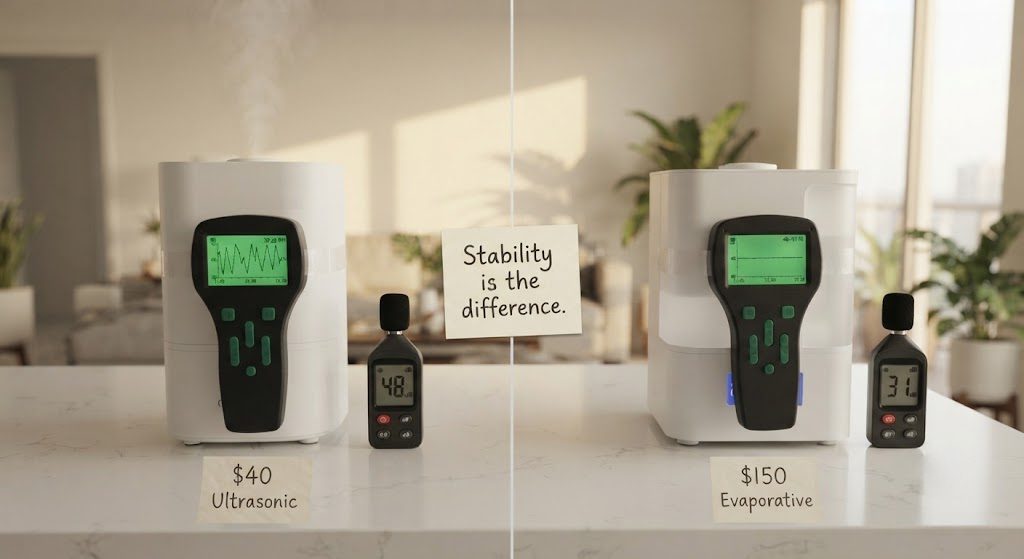
On its lowest setting, it was nearly silent — 28 dB on my meter, barely above the ambient noise of the room. The problem was the output. At that speed, it raised humidity by only 3-4 percentage points overnight. To make a meaningful difference, I had to run it on high, and high was 48 dB. That's not white noise territory — that's "I can hear the water gurgling and the fan whining" territory. Sleep quality took a hit.
The humidity graph told an even less flattering story. The budget unit cycled its output based on the tank level and the tiny transducer plate's capacity. The result was a sawtooth pattern: humidity would spike after the unit kicked on, then slowly fall until the cycle repeated. Overnight, my bedroom bounced between 38% and 52% RH. That's not stability. That's a moisture rollercoaster.
Refill frequency: I topped off the small tank twice a day — once before bed, once in the morning. Not a dealbreaker, but an annoyance that added up over two weeks.
The $150 Evaporative: Set It and Forget It
The premium unit used evaporative technology — a wick draws water upward, and a fan blows air through the wet wick. No visible mist, no white dust, no ultrasonic plate to descale. It had a digital humidistat and an auto mode that targeted a set humidity level.
I set it to 50% on night one and didn't touch it again for the rest of the test. The humidity logger showed a nearly flat line overnight: 48% to 51% RH, with a deviation of less than 2 percentage points. The fan noise at its auto speed stayed at 31 dB — audible but smooth, the kind of sound that blends into background noise.
The trade-off was the size. The unit was significantly larger, the wick needed replacement every two months (a $12 ongoing cost), and the tank, while bigger, was more awkward to refill. But the experience was hands-off in a way the budget unit simply couldn't match.
Is the Premium One Worth $110 More?
It depends on what you value. If you're in a dry climate and run a humidifier nightly for months at a time, the stability, quiet, and low-maintenance operation of the $150 unit is absolutely worth the upgrade — especially if you're sensitive to noise during sleep. The humidity consistency alone justified the price for me.
If you only need a humidifier for a few weeks a year, or you're in a small dorm room where space matters, the $40 unit will raise the humidity and keep your sinuses from complaining. Just expect to refill it often, clean it more, and tolerate some noise on higher settings.
I kept the premium unit in my bedroom. The budget one went to the guest room, where it serves occasional duty and doesn't keep anyone awake.