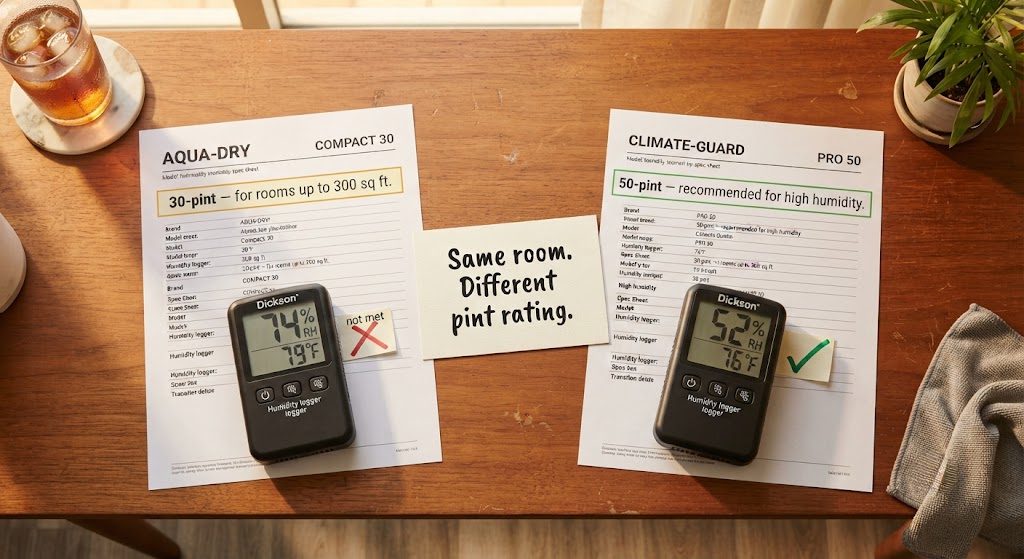
The first dehumidifier I ever bought was a 30-pint model — the size the internet told me was right for a 300-square-foot bedroom. It ran constantly. The bucket filled up twice a day. And my humidity logger, sitting on the nightstand, barely budged. I was pulling 30 pints of water out of the air every 24 hours, and the room was still sitting at 74% relative humidity. According to the manufacturer's spec sheet, I had the right machine. According to my walls — which were starting to smell faintly of mildew — I absolutely did not.
That was my introduction to the single most misunderstood number in moisture control: the pint rating.
What the Pint Rating Actually Means
A dehumidifier's pint rating tells you how many pints of water it can remove from the air in 24 hours — under very specific conditions. In the United States, the current Department of Energy test standard (since 2019) is 65°F and 60% relative humidity. Older units might still use the pre-2019 standard of 80°F and 60% RH. Either way, these are moderate conditions. They're not a Miami summer.
When the air is warmer and wetter — say, 82°F and 78% RH — the same machine can remove significantly more water per day, because there's simply more water in the air. A unit rated for 30 pints at 65°F/60% might pull 50 or 55 pints under tropical conditions. That sounds like good news, but here's the catch: if the room is large and the humidity load is high, even 55 pints might not be enough to bring the RH down to a safe level. The pint rating tells you the machine's extraction capacity at one snapshot in time. It doesn't tell you how fast it can drop the humidity in a 400-square-foot room that's been soaking up moisture for weeks.
How to Size a Dehumidifier for a Humid Climate
After that first failure, I started logging data on every dehumidifier I tested — pint ratings, actual water collected per 24 hours, room size, starting RH, and ending RH after 48 hours of continuous operation. Here's the rule of thumb that actually works for climates like Miami:
Throw out the "square footage" recommendation on the box. It almost always assumes a moderately damp basement in a temperate climate, not a coastal bedroom with the window cracked and a rainstorm outside.
Use the 2-pints-per-100-square-feet rule — at 80% RH. For a 300-square-foot room that regularly hits 75-80% humidity, you want at least a 50-pint unit (under the new DOE standard). That's a "large room" dehumidifier by store labels, but in my testing, it's the bare minimum.
For really damp spaces — ground-floor apartments, laundry rooms, closets with exterior walls — go up a size. A 50-pint unit in a 200-square-foot closet might sound like overkill, but it'll cycle on and off and maintain 50% RH without running constantly. A smaller unit will struggle and never shut off.
Continuous drainage is non-negotiable if you're pulling more than 30 pints a day. Emptying a bucket twice a day gets old fast. Most serious units have a gravity drain port or a built-in pump. Use it.
The Miami Reality Check
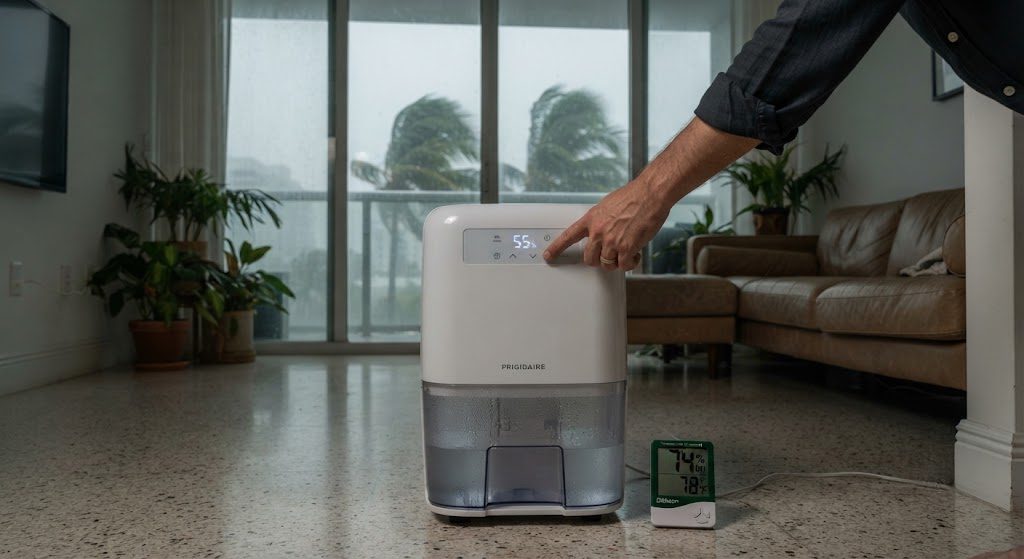
Last August, I tested a 50-pint dehumidifier in my 350-square-foot living room. Starting RH was 79%. After 48 hours, it settled at 52% — a fantastic result. The unit ran about 14 hours a day. Electricity cost: roughly $18 for the month. That's the kind of performance you need when outdoor humidity averages 80% and you're trying to keep indoor air from feeling like soup.
A 30-pint unit in the same room, same starting conditions, topped out at 64% RH after 48 hours. That's still mold-friendly territory. It wasn't a bad machine — it was just undersized for the climate.
Don't buy a dehumidifier based on the square footage on the box. Buy it based on how much water your air actually holds. In Miami, that's always more than you think.