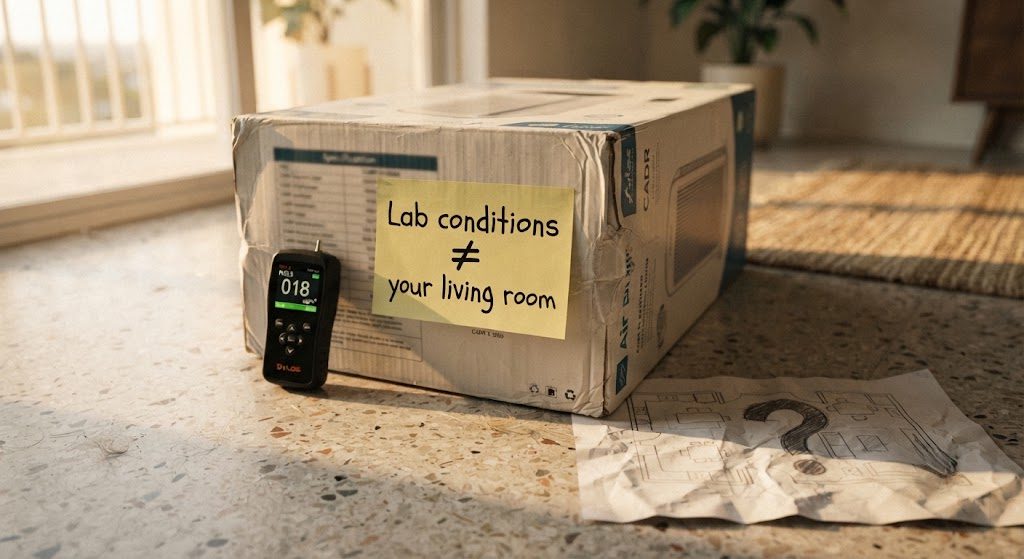
CADR — Clean Air Delivery Rate — is the most useful number on an air purifier box and the most misunderstood. It tells you how many cubic feet of clean air a machine delivers per minute, measured for smoke, pollen, and dust. What it doesn't tell you: that test happened in a sealed chamber the size of a walk-in closet, not your open-plan living room with Miami humidity rolling through the window gaps. I've tested purifiers with near-identical CADR ratings that performed completely differently in a real 400-square-foot space. Once you understand what CADR actually measures — and, more importantly, what it ignores — you'll never overpay for a machine that's overqualified for a shoebox and underqualified for your home.
Post Content (~500 words)
The CADR Number on the Box — How to Read It So It Actually Means Something
Every air purifier worth its salt has a CADR label. It's usually on the side of the box in a tidy grid: Smoke CADR, Dust CADR, Pollen CADR. The numbers look authoritative. The problem is, they were generated in a laboratory chamber that shares almost nothing with your apartment.
I've run side-by-side tests in my Miami living room — same particle source, same starting concentration, same calibrated particle counter — and watched two units with identical Smoke CADR ratings clear the air at wildly different speeds. The spec sheet said they were equals. The meter disagreed.
What CADR Actually Measures
CADR stands for Clean Air Delivery Rate. It's measured in cubic feet per minute (CFM) and tells you how quickly a purifier can filter particles of a specific size — smoke particles are small (0.09–1.0 microns), dust particles are medium, pollen particles are large. A higher CADR means faster cleaning for that particle size.
The test happens in a sealed chamber roughly 100 square feet with controlled temperature, controlled humidity, and zero new particles entering. A machine is placed exactly where the manufacturer wants it, and the particle decay rate is measured. The resulting number is clean, repeatable, and useful for comparing purifiers in a vacuum.
Your home is not a vacuum.
Why Your Living Room Breaks the CADR Formula
The most common advice you'll find online is the "two-thirds rule": take your room's square footage, multiply the CADR by 1.55, and if the result is larger than your square footage, you're good. That math works in a sealed box. In a real home, here's what it ignores:
Air exchange with other rooms. If your living room opens into a kitchen and hallway without doors, you're not treating 300 square feet. You're treating 800.
Humidity. Here in Miami, particle counters behave differently when relative humidity is above 70%. Particles clump. Sensors lag. Filters load faster.
Furniture and airflow obstruction. A CADR test assumes an empty room. Your couch, bookshelf, and the corner you shoved the purifier into all reduce effective cleaning rate.
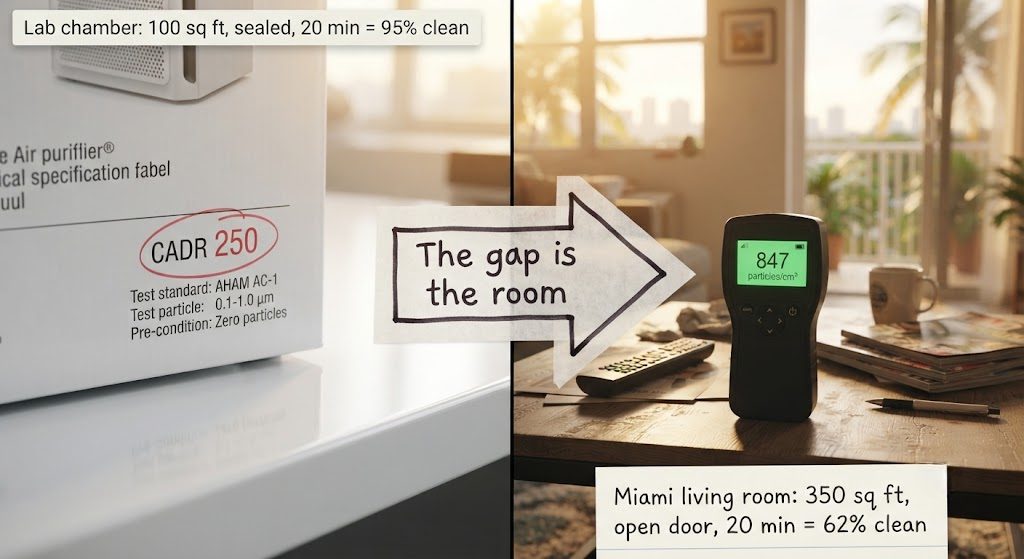
I tested a popular purifier with a Smoke CADR of 250 in my 350-square-foot living room with the kitchen doorway open. At the 20-minute mark, particle concentration had dropped by only 62%. In a sealed bedroom test with the door closed, the same unit hit 95%. Same machine, same particle source, entirely different result. The CADR number didn't change — but the room did.
How to Use CADR Without Getting Burned
Here's how I size a purifier for a real home:
Ignore the room size on the box. It's almost always optimistic.
Take the Smoke CADR and divide by 1.5. That's your realistic square footage for an open-plan space. For a sealed bedroom, divide by 1.2.
Buy more CADR than you think you need. A unit running at medium speed is quieter, uses less energy, and still outperforms a maxed-out smaller unit.
Pay attention to the Smoke CADR specifically. If a manufacturer only lists Dust CADR, they're hiding something. Smoke particles are the hardest to capture and the most relevant to your lungs.
CADR is not useless — it's the best starting point we have. But it's a lab number, not a living-room number. Use it as a filter, not a promise. Your particle counter will thank you.