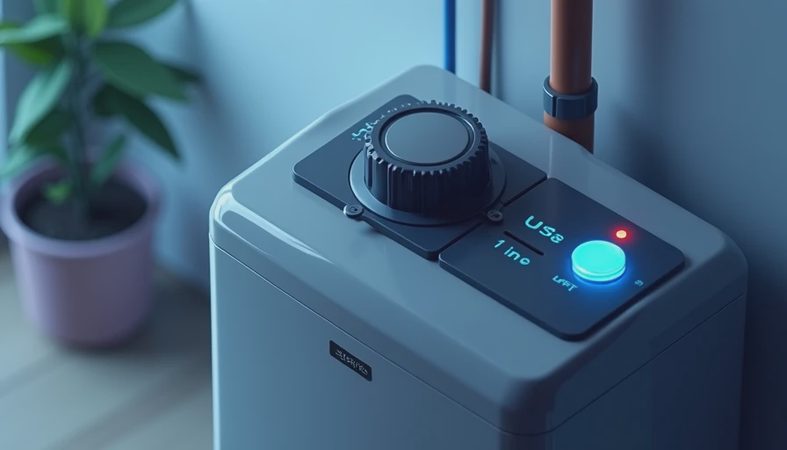
The air purifier I tested for this piece costs a little over $500. It has a sleek touch panel, a laser particle sensor, Wi-Fi connectivity, and an Auto mode that the manufacturer claims "intelligently adjusts to real-time air quality." On paper, it's exactly the kind of machine that should dominate a particle test. In my living room, with a cigar as the smoke source, it did not dominate. It took a nap.
The Test Setup
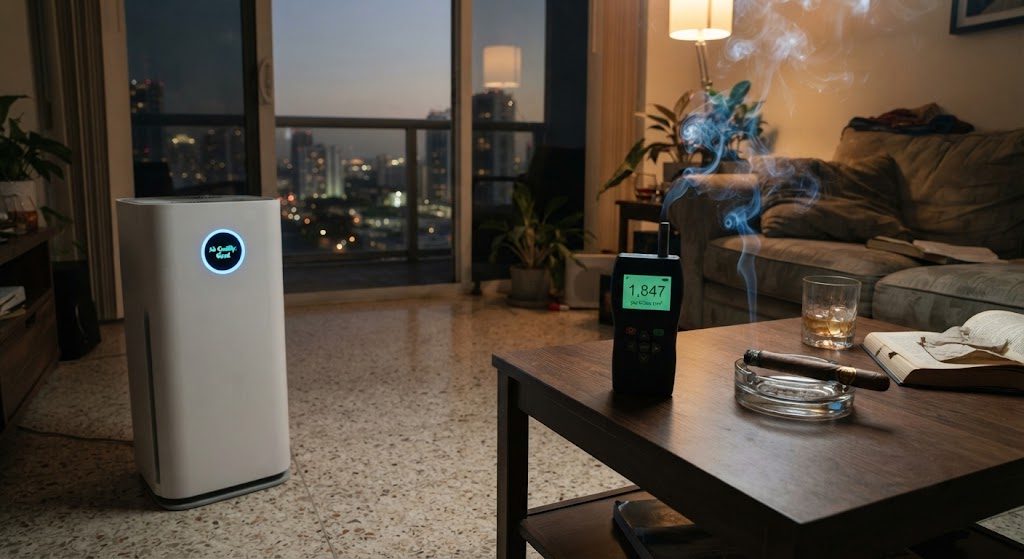
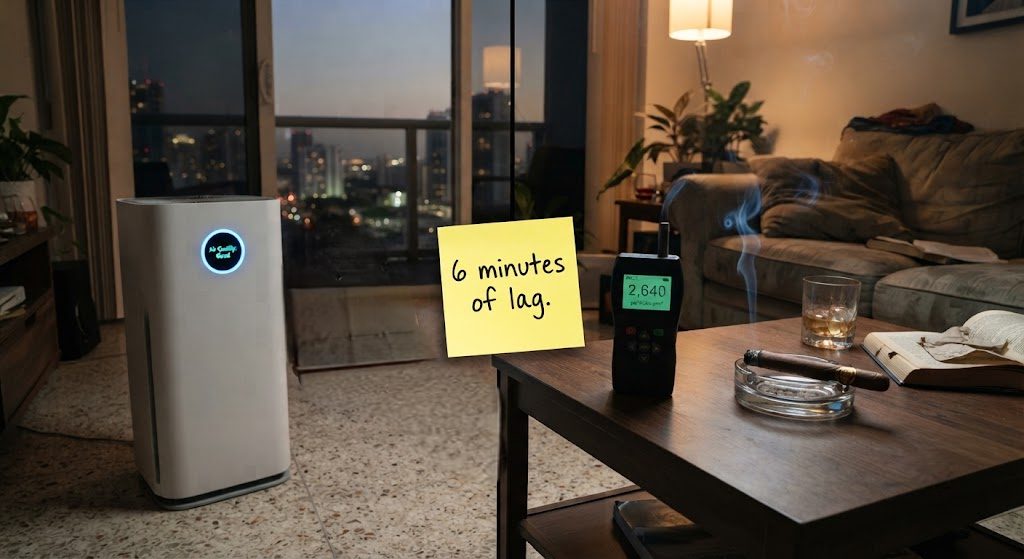
I kept conditions as controlled as possible without building a cleanroom. My living room is roughly 350 square feet, open to a small hallway. I placed the premium purifier on the floor where the manufacturer recommends — away from walls, unobstructed. I set a calibrated particle counter on the coffee table six feet away, logging PM2.5 every ten seconds. The purifier was in Auto mode, which I had not touched for 24 hours. Its display read "Good" with a calm blue ring.
My smoke source: the weekly cigar. I lit it on the balcony, took a few draws, then stepped inside and walked past the purifier to the center of the room. I didn't blow smoke directly at the sensor — I just moved through the space the way anyone would. Then I sat down and watched the numbers.
Seven Minutes of Nothing
The particle counter reacted immediately. Within 60 seconds of me re-entering the room, the PM2.5 reading jumped from a baseline of 4 µg/m³ to 187 µg/m³. By the three-minute mark, it hit 2,640. The air was visibly hazy near the window. I could smell the smoke clearly.
The premium purifier? Its display remained blue. Fan speed did not change. For six full minutes, the machine sat there in its lowest, quietest state while a measurable smoke cloud drifted two feet above it. At the 6-minute-42-second mark, the sensor finally triggered. The ring turned yellow, then orange. The fan ramped up to about 60% of maximum. Better late than never, I suppose.
Here's the kicker: once the fan finally engaged, it took another 22 minutes to bring PM2.5 back below 15 µg/m³. Total elapsed time from smoke entry to clean air: just under 29 minutes.
Manual Mode Would Have Cut That in Half
After the room cleared, I repeated the test — same cigar, same entry, same starting particle count — but this time I manually set the purifier to maximum fan speed the moment I walked inside. The particle counter hit 2,580 µg/m³, then immediately began a steep decline. PM2.5 dropped below 15 in 11 minutes. That's 18 minutes faster, with no sensor lag, no waiting for an algorithm to figure out the obvious.
The lesson here isn't that Auto mode is useless. It's that Auto mode is tuned to avoid false alarms and annoying noise, not to protect you from acute smoke events. The algorithm prioritizes a quiet, pleasant user experience over rapid response. That's fine if you're dealing with gradual dust accumulation. It's not fine if you're dealing with cooking fumes, a neighbor's wildfire smoke, or — yes — a cigar.
I don't think this machine is broken. I think it's working exactly as designed. The design just values silence over speed. If you own a premium purifier, use Auto mode for background maintenance. For anything that spikes your particle counter fast, reach for the manual controls. The blue light lies.