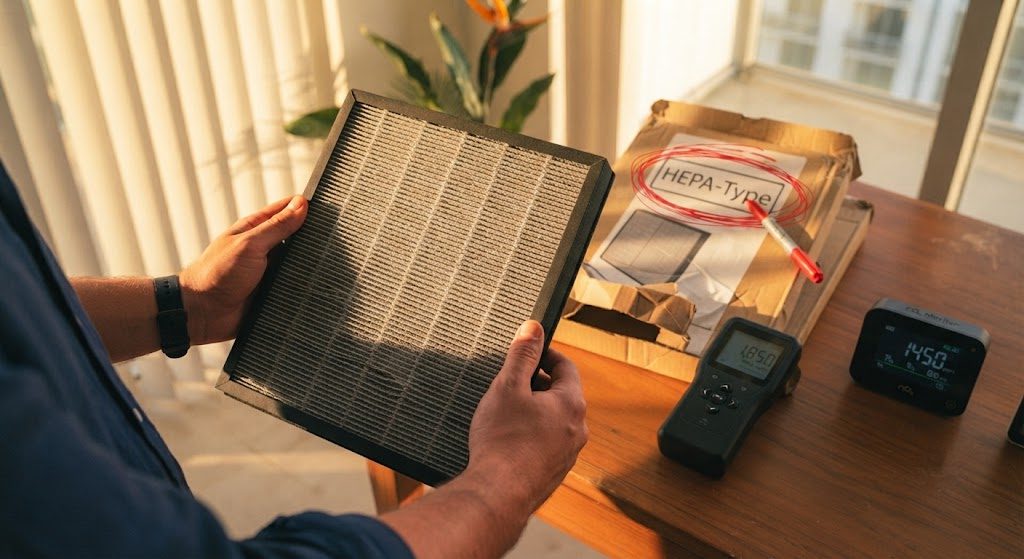
The first time I pulled a "HEPA-Type" filter out of a $120 air purifier, I held it up to my window and could see individual specks of Miami sunlight through the fibers. That's not science — that's just a bad sieve. I ran it on the bench anyway. The particle counter told me exactly what I suspected: it was capturing roughly 85% of 0.3-micron particles. A genuine HEPA filter captures 99.97%. That gap isn't a rounding error. It's the difference between breathing clean air and paying for a plastic box that makes noise.
What HEPA Actually Means
HEPA is not a vibe. It's a measurable standard. In the United States, a filter must remove at least 99.97% of particles 0.3 microns in diameter to earn the label, per Department of Energy specifications. The European standard (EN 1822) classifies filters from E10 to H14, with H13 and H14 being what most people mean when they say "medical grade." A true HEPA filter — whether labeled H13 or meeting the U.S. DOE definition — is a dense mat of randomly arranged fibers that captures particles through interception, impaction, and diffusion. It's tested. It's certified. It's not open to interpretation by a marketing intern.
"True HEPA" is essentially a consumer-friendly way of saying "this meets the HEPA standard." It's redundant but at least signals some attempt at compliance. Where the rot creeps in is everything else.
The Terminology Trap
Walk down a virtual aisle and you'll see:
HEPA-Type — This means nothing. There is no standard, no certification, no required efficiency. Often a polyester mesh that catches dust bunnies and little else.
HEPA-Like — Even worse. Usually found on budget desktop purifiers with a USB fan and a felt pad.
HEPA 10 / EPA — Technically a real European classification (E10), but only 85% efficient at 0.3 microns. Not true HEPA.
Medical Grade HEPA — A marketing term with no regulatory definition. Could be H13. Could be hot air.
I tested a popular "HEPA-Type" purifier with a calibrated particle counter last year. At the 0.5-micron channel, it reduced particle count by only 58% after 30 minutes on maximum fan speed. A genuine H13 unit sitting on the same shelf, same room, same starting particle load from a blown-out match: 99.5% reduction in 18 minutes. The cost difference was $40.

How to Read a Spec Sheet Without Getting Fooled
When you're looking at an air purifier listing, ignore the adjectives. Look for these three things:
"Meets HEPA standard H13" or "99.97% at 0.3 microns" — That's the real deal. Bonus points if the filter is independently tested and certified.
Filter area and thickness — A thin, small filter can't hold much particulate. More media area means longer life and better efficiency.
Sealed filter housing — I've tested units where air bypassed the filter entirely because the housing didn't seal tight. No certification saves you from bad engineering.
I've now reviewed over 150 air purifiers. The $60 unit with a genuine H13 filter beats the $300 lifestyle brand with a "HEPA-Type" insert every single time — and I have the particle counter logs to prove it. Don't pay extra for adjectives. Pay for the filter that actually filters.