Miami tap water is a mixed bag. It's treated, it's tested, it's legally safe — but it arrives at my tap carrying a faint chlorine smell, around 220 mg/L of total dissolved solids (TDS), and the kind of hardness that leaves spots on glassware if you don't dry it immediately. When friends ask me if they should start filtering their water, I almost always say the same thing: a Brita pitcher is a perfectly reasonable place to start. But let's be clear about what you're actually getting for your $20.
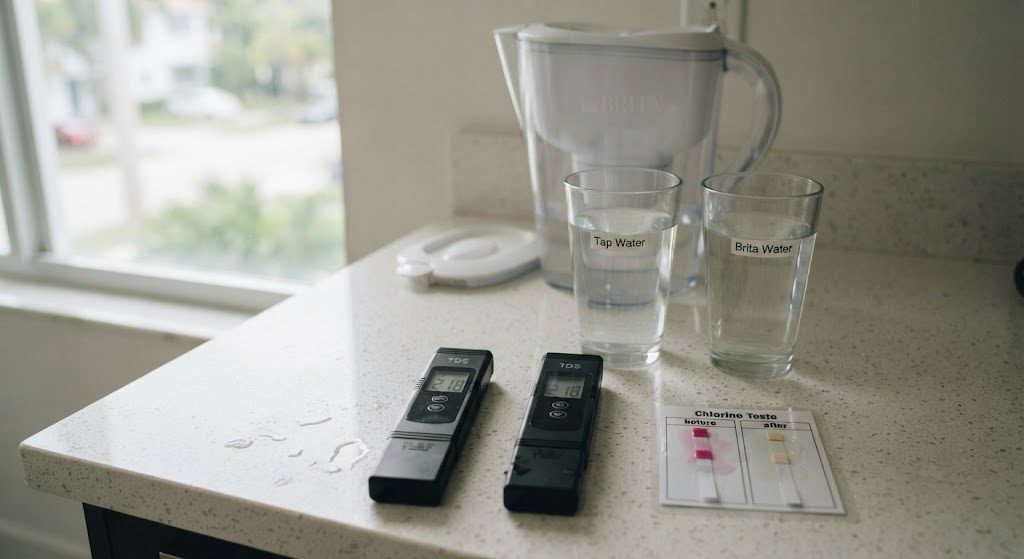
I tested a standard Brita pitcher with a fresh filter against my unfiltered Miami tap water across three dimensions: chlorine reduction, TDS change, and blind taste preference. Here's what the meters said.
What a Brita Does Well
The core of a Brita filter is activated carbon — coconut-shell-derived, in the standard model — with a small amount of ion-exchange resin mixed in. Activated carbon is genuinely good at one thing: adsorption of organic compounds that cause taste and odor issues. Chlorine, in particular, grabs onto the carbon surface and stays there.
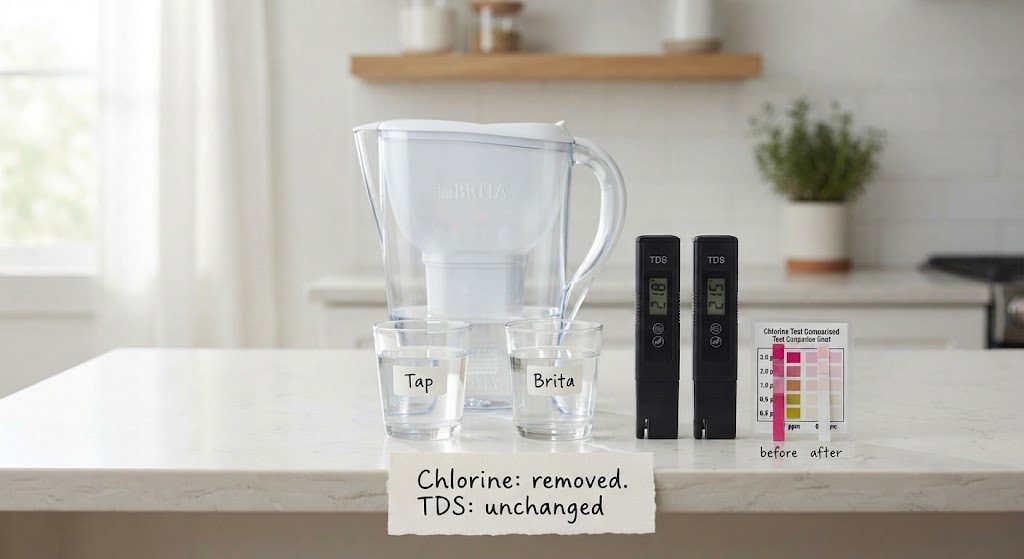
I ran a free chlorine test strip on my tap water before and after filtration. The unfiltered sample registered around 2.0 ppm — enough to smell. After a single pass through the Brita, the strip showed less than 0.5 ppm, which is effectively undetectable to my nose. The improvement was immediate and reproducible. If your main complaint about tap water is that it tastes like a swimming pool, a Brita solves that problem for pennies per gallon.
In the blind taste test with three friends, the Brita-filtered water won unanimously against unfiltered Miami tap. "Cleaner," "no aftertaste," "doesn't smell like anything" were the comments. That's a real win at this price point.
What It Doesn't Touch
Now for what stayed in the water. I measured TDS before and after with a calibrated meter: 218 mg/L in, 215 mg/L out. That 3-point drop is within the meter's margin of error. TDS measures dissolved minerals, salts, and metals — and a basic carbon filter does almost nothing to remove them. If you're concerned about lead (which can leach from old pipes), fluoride (added by most municipal systems), or microplastics (increasingly common in tap water samples), a standard Brita is not your solution. There are Brita models with "Longlast+" or "Elite" filters that claim lead and some heavy metal reduction, but the classic pitcher filter you've probably owned for years doesn't.
Water hardness — calcium and magnesium — also passed through unchanged. If you're trying to stop scale buildup in your kettle or coffee maker, this filter won't help.
The Verdict
Brita is a taste-and-odor filter, and it's a good one. For $20 and a $5 filter every two months, you get water that tastes noticeably better and smells like nothing, which is more than I can say for the tap in half the Miami apartments I've tested. But if you're looking for meaningful TDS reduction, heavy metal removal, or anything approaching purified water, you're going to need a different tool — activated carbon block with ion exchange, an under-sink reverse osmosis system, or a countertop distiller.
Use the Brita. Enjoy it. Just know what job it's actually doing.