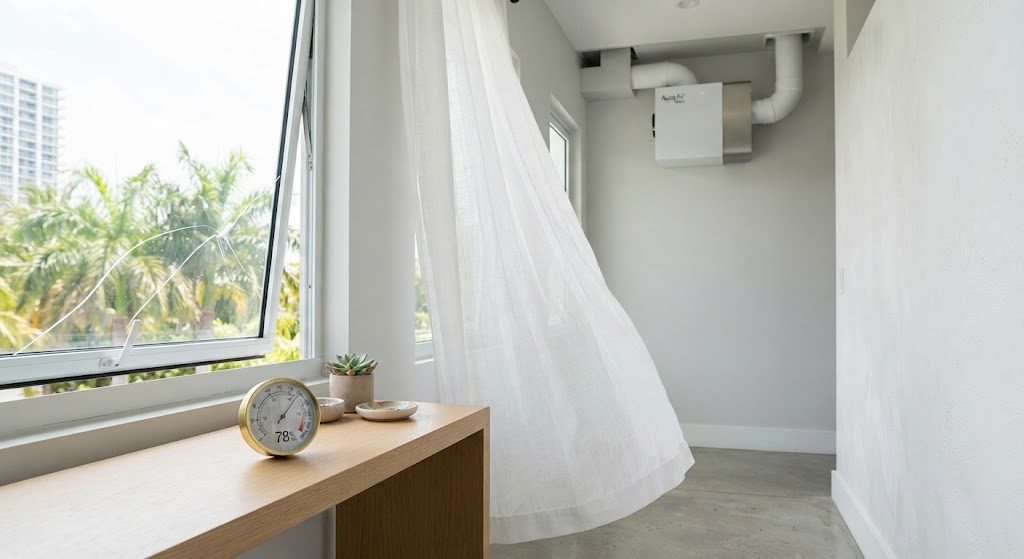
I spent years thinking ERVs — Energy Recovery Ventilators — were for passive houses in cold climates. The kind of niche device that shows up on building science YouTube channels and nowhere else. Then I spent a summer in a tightly sealed Miami townhouse where the CO₂ regularly climbed past 1,800 ppm by morning, and I realized the choice isn't between an ERV and nothing. It's between an ERV and the compromises you're already making: stuffy air, open windows that let in 80% humidity, or running the bathroom exhaust fan and praying.
An ERV is essentially a controlled air exchange system. It pulls stale indoor air out, brings fresh outdoor air in, and passes both streams through a heat-and-moisture-exchange core. In summer, the outgoing cool, dry air pre-cools and dehumidifies the incoming hot, wet air. In winter — not that Miami has one — the process reverses. The result is fresh air without the energy penalty of opening a window. But installed costs run from $2,000 to $4,000 depending on ducting complexity. The question is: when does that math actually work?
The Test Setup
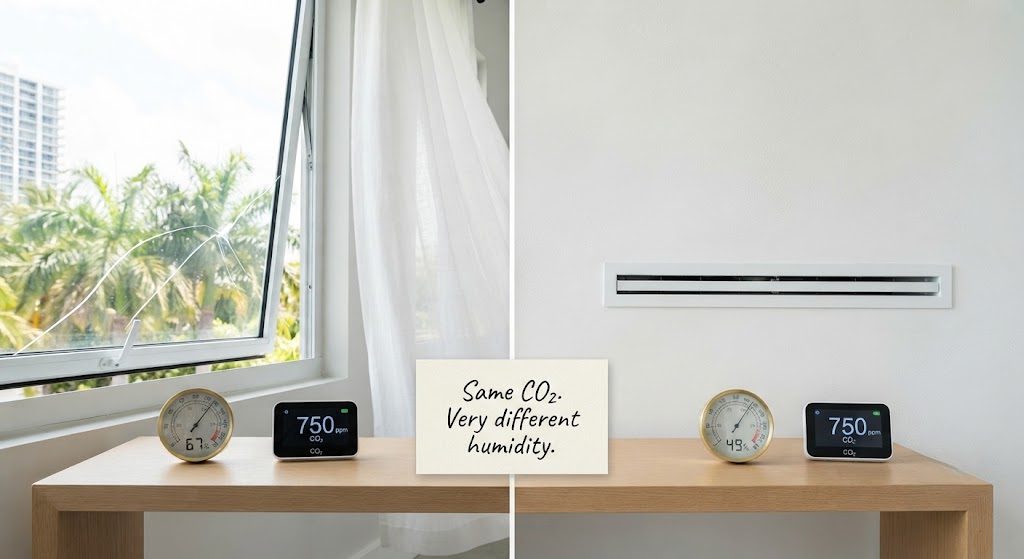
A friend with a 1,800-square-foot townhouse let me install an ERV for a six-week test during August and September. The house was built in 2018, reasonably tight, with spray foam insulation and double-pane windows. Before the ERV, the baseline was this: with windows closed and AC running, CO₂ levels in the master bedroom hit 2,200 ppm overnight with two adults sleeping. That's solidly into the territory where cognitive performance and sleep quality degrade. The fix was to crack a window, but outdoor humidity at 85% drove the indoor humidity from 48% to 67% within two hours, making the AC work overtime.
I installed a mid-range ERV with a dedicated duct run to the bedrooms and a single return in the hallway. It ran continuously on low speed, exchanging about 70 cubic feet per minute — enough for roughly three air changes per day. I tracked CO₂, indoor temperature, indoor humidity, and AC compressor runtime for three weeks before and three weeks after the install.
What the Meters Said
The results were unambiguous. Bedroom CO₂ dropped from an overnight peak of 2,200 ppm to a steady 750 ppm — barely above outdoor levels. Indoor humidity, which had spiked to 67% with a window cracked, stayed at 48–50% with the ERV running. The moisture-exchange core was doing its job, rejecting the majority of incoming humidity before it entered the living space. AC runtime actually decreased by about 8%, because the unit wasn't fighting the latent load of wet outdoor air.
The ERV's power draw was negligible — about 35 watts on low speed, or roughly $3 per month in electricity. The real cost was the install, and that's the part that makes or breaks the decision.
When an ERV Is Worth It
If your home is newer, tightly sealed, or recently weatherized, an ERV will make a measurable difference in air quality without sabotaging your humidity control or energy bills. You'll notice it most in bedrooms at night and in homes where someone has allergies or asthma — the constant filtered fresh air is a meaningful upgrade over recirculated AC air.
If you're already planning ductwork for a renovation or new build, adding an ERV at that stage is significantly cheaper and absolutely worth doing. The incremental cost during new construction can be as low as $1,500, which is a bargain for year-round fresh air.
When a Window Works Fine
If your home is older and naturally leaky — single-pane windows, unsealed doors, the kind of place where the curtains move when the wind blows — you already have air exchange. It's uncontrolled and inefficient, but it's there. An ERV won't fix that; air sealing and insulation will give you far more bang for your buck. If you're in a dry climate where opening a window doesn't carry a humidity penalty, you also don't need an ERV. A window and a box fan will do the job for free.
For Miami specifically, the humidity recovery alone makes an ERV compelling in any home built in the last 20 years. If you're waking up groggy and your CO₂ meter confirms it, an ERV isn't overkill. It's the appliance that fixes what a sealed building breaks.