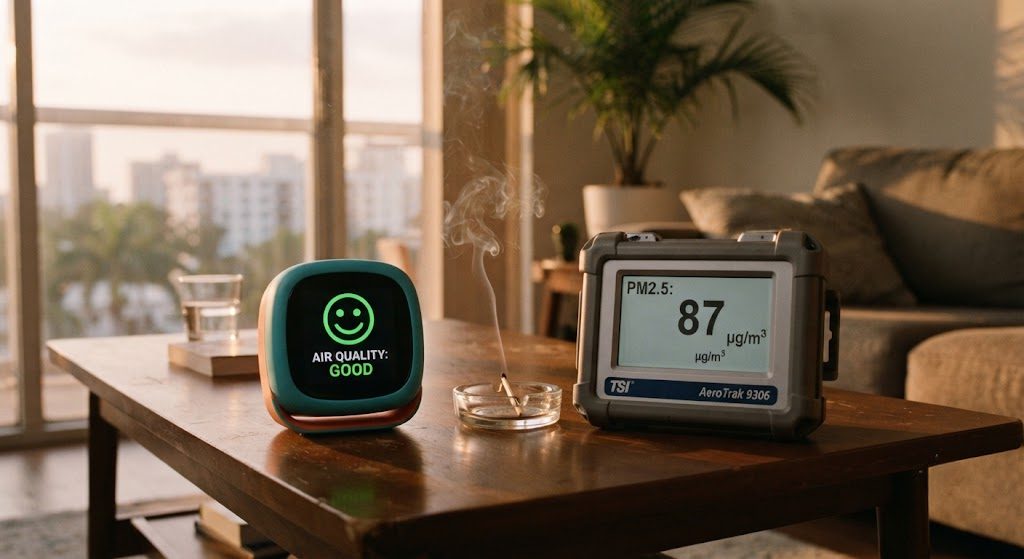
Indoor air quality monitors have become a consumer category of their own. You can buy a compact unit for $40 that promises real-time PM2.5 readings, a color-coded air quality index, and a reassuring smiley face when everything's fine. I wanted to know if the numbers behind that smiley face mean anything. So I placed a popular budget monitor next to my calibrated reference meter — a $300 industrial unit I use as a baseline for all my appliance tests — and ran it through three real-world scenarios. The budget unit didn't just fudge the numbers. It told a completely different story.
Test 1: Cigar Smoke
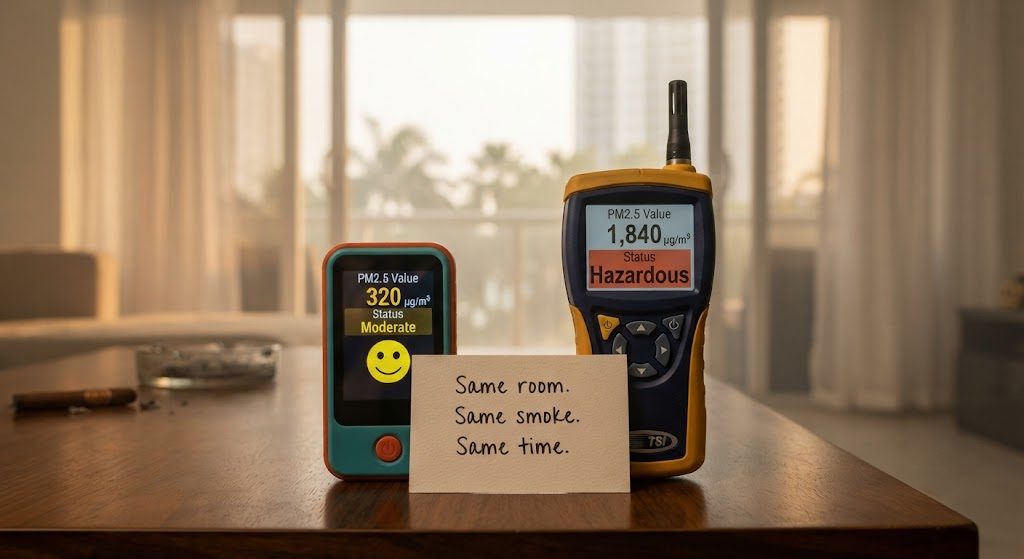
I lit a cigar on the balcony, walked inside, and let the smoke plume drift through my living room. My reference meter detected the spike immediately: PM2.5 jumped from a baseline of 5 µg/m³ to 1,840 µg/m³ within 90 seconds. The $40 unit, set to its fastest sampling interval, took four minutes to respond. When it finally did, it displayed a reading of 320 µg/m³ — a factor of nearly six lower than the reference. Worse, its color-coded indicator stayed in the "Moderate" yellow zone, which the manual defines as "acceptable for most people." The reference meter was screaming that the air was hazardous. The budget unit was politely suggesting I open a window sometime.
That lag isn't just annoying. If you're relying on a consumer monitor to tell you when cooking smoke or wildfire drift has made your indoor air unsafe, a four-minute delay and an 83% undercount means you'll be breathing bad air long after you should have acted.
Test 2: Cooking Fumes
I seared a steak in a cast-iron pan — no exhaust fan running, kitchen open to the living room. My reference meter climbed to 480 µg/m³ and stayed elevated for over an hour. The budget unit peaked at 95 µg/m³, then dropped back to "Good" within 20 minutes while the reference still showed 210 µg/m³. The budget sensor appeared to have a ceiling on its sensitivity to the specific particle sizes cooking produces. It was as if the sensor saturated early and gave up trying to count higher.
Test 3: Humidity Spike
Consumer PM2.5 sensors use laser scattering, which is sensitive to moisture. When I raised the room's relative humidity from 55% to 82% by boiling water with no ventilation, the reference meter's PM2.5 reading didn't change significantly — the particles in the air weren't changing, just the moisture content. The budget unit, however, jumped from 12 µg/m³ to 145 µg/m³, flashing a red "Unhealthy" warning. There was no actual pollution. The sensor was reading water droplets as particulate matter. A false alarm, but a convincing one.
Is a Budget Monitor Better Than Nothing?
It depends on what you're using it for. If you want a general sense of whether your air is trending better or worse — and you understand that the absolute numbers are likely wrong — a $40 monitor can show you when a purifier is making a difference or when cooking impacts air quality. The relative changes can be useful even if the scale is off. But if you're using the monitor to make health decisions, to know when to wear a mask, or to verify whether an expensive air purifier is working, a consumer unit that undercounts smoke by 83% and mistakes humidity for pollution is worse than useless. It's misleading.
I use a calibrated reference meter because I publish data people rely on. You don't need a $300 unit. But if you can stretch to a $100–$150 monitor from a brand that publishes its sensor specifications and accuracy range, you'll get readings that are directionally correct and responsive. Skip the smiley faces. Buy the one that shows numbers, and know what those numbers can — and can't — tell you.