I love my dog. What I don't love is the dander coating my desk by Thursday and the couch smelling like damp fur by the weekend. After testing 150 air purifiers in Miami over five years, I've found the best pet air purifier for most homes: one that handles both particles and odors. It doesn't have to be the priciest unit either. Here's what I measure, what I look for, and which machines actually earned a spot in my apartment.
Why Pets Change the Air Purifier Game
Pets add two problems: dander and odor. Dander flakes are heavy, so they settle on floors and fabric. A HEPA filter catches those. But wet dog smell, litter box ammonia, and pet oils are VOCs, and a HEPA filter alone ignores them. You need a carbon layer to adsorb those gases. When I shop for a pet air purifier, I look for a two-stage system. Skip the carbon and it fails before I even plug it in.
What to Look For in a Pet Air Purifier
You need three things: a true HEPA filter, a real carbon layer, and enough airflow. Look for HEPA H13 or H14, not "HEPA-like." A washable pre-filter helps too—it catches fur before it clogs the main filter. The carbon should be a quarter inch of pellets, not a foam sheet. CADR tells you how fast it cleans. For a 300-square-foot living room, aim for a CADR of 200 or higher. The right pet air purifier balances all three.
My Test Setup in Miami
Miami's humidity sits around 80 percent most of the year, making it a brutal test bench. I run a laser particle counter on one side of the room, a VOC meter on the other, and introduce a controlled smoke source—usually an incense stick or a lit cigar. Good machines drop the particle count fast; overpriced ones leave a lingering haze. I also spray a vinegar-water mix to check VOC response. I tested every pet air purifier on this bench this year, and the results separated real winners from fans with LED rings.
The Picks That Earned My Recommendation
Three models rose to the top after all that testing.
The Levoit Core 300 is the value pick. It has a real HEPA, a carbon layer that adsorbs, and enough airflow for a small to medium room. It sells for around $100, replacement filters run $30, and in my smoke test it cleared a 320-square-foot room in under 20 minutes. For a one-bedroom apartment with a cat, this is the pet air purifier I recommend first.
The Coway Airmega AP-1512HH is the mid-range champion. It uses a washable pre-filter, true HEPA, and a loaded carbon filter. It runs around $200, filters cost about $50, and its auto mode caught my cigar smoke from across the room before I could stub the cigar out.
The Blueair Blue Pure 311 handles larger spaces and heavy shedders. Blueair's combo filter handles both particles and odors, and the unit is rated for up to 540 square feet. At $250, it costs more, but it's whisper quiet and easy to maintain.
The Maintenance Trap Everyone Ignores
A pet air purifier only works if you keep it maintained. I see too many people let a gray, hair-caked pre-filter sit for six months. Airflow drops, CADR falls, and the motor strains. Check the pre-filter every two to four weeks if you have a pet. I wash mine twice a month. The main HEPA filter needs replacement every six to twelve months, so factor filter costs into your budget. A $100 machine with $50 filters every six months is pricier than a $200 machine with $30 filters.
Red Flags That Scream "Fan with an LED Ring"
Look out for "ionizer only" machines or "UV light" claims. Those don't remove pet dander or odor. Also avoid any unit with a filter you can only replace through a weird subscription, and check the decibel rating. A pet air purifier for a bedroom should run under 35 dB on low. If the company brags about "quiet operation" but doesn't list a dB number, that's a red flag. Also, don't trust CADR numbers from the manufacturer if they're not third-party verified. I've seen units claim 400 CADR but struggle to move air across a 200-square-foot room. In Miami's humidity, ionizers also produce ozone concerns, so I skip them entirely.
How to Get the Most Out of It
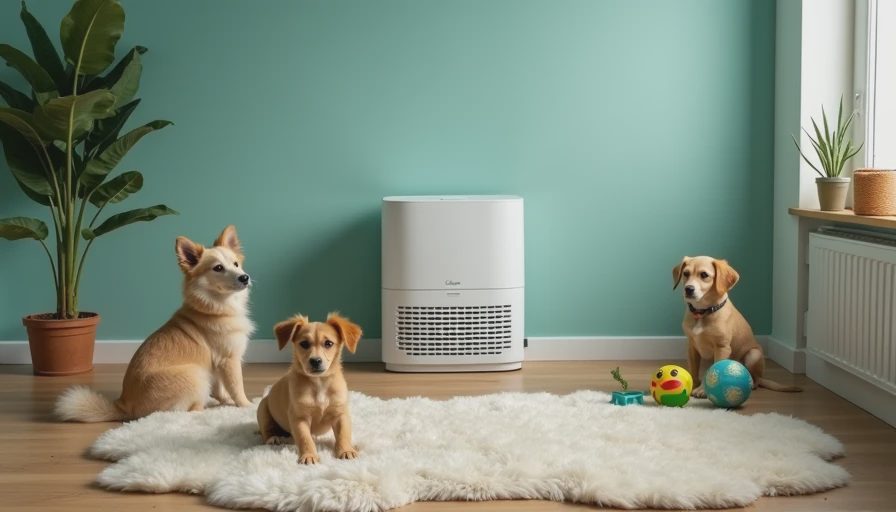
Put your pet air purifier in the room where your pet hangs out, not the hallway. Keep it a foot from walls so the intake and outlet stay clear. Run it on high during the day and switch to sleep mode at night. If you're gone for a few days, turn it off; a machine running 24/7 with no one home is just burning electricity.
At the end of the day, the right pet air purifier makes your home smell like nothing without breaking the bank. My money is on the Levoit for most people. For bigger spaces or heavier shedders, the Coway or Blueair is worth the extra dollars. The difference between a clean home and a musty one comes down to running the machine consistently.