Miami tap water is chlorinated — and in some neighborhoods, chloraminated — to keep it safe. That's good public health policy, but your skin and hair don't care about policy. Chlorine strips natural oils, dries out skin, fades color-treated hair, and turns a morning shower into a mild chemical rinse. Shower filters promise to fix that for a fraction of the cost of a whole-house system. I bought three of the most popular ones and tested them the only way that matters: with free chlorine test strips, before and after.
The Contenders
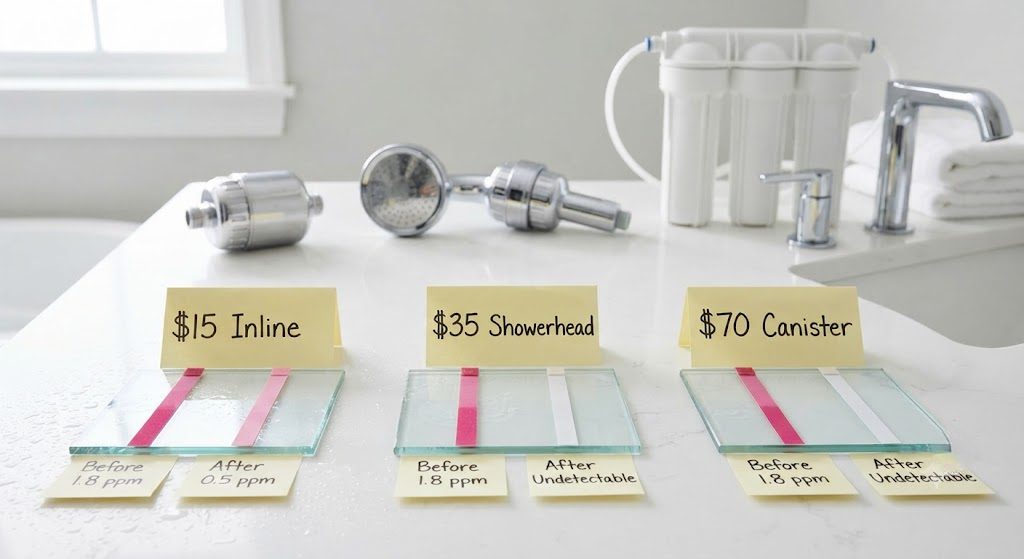
I picked units at three price points. The first was a basic $15 inline filter that screws between the pipe and the showerhead — a simple tube filled with KDF (kinetic degradation fluxion) media and calcium sulfite. The second was a $35 filtered showerhead with a combination of KDF, activated carbon, and ceramic beads. The third was a $70 multi-stage canister that claims to filter chlorine, heavy metals, and sediment. All were easy to install with no tools, though the $70 unit was heavier and required a support bracket.
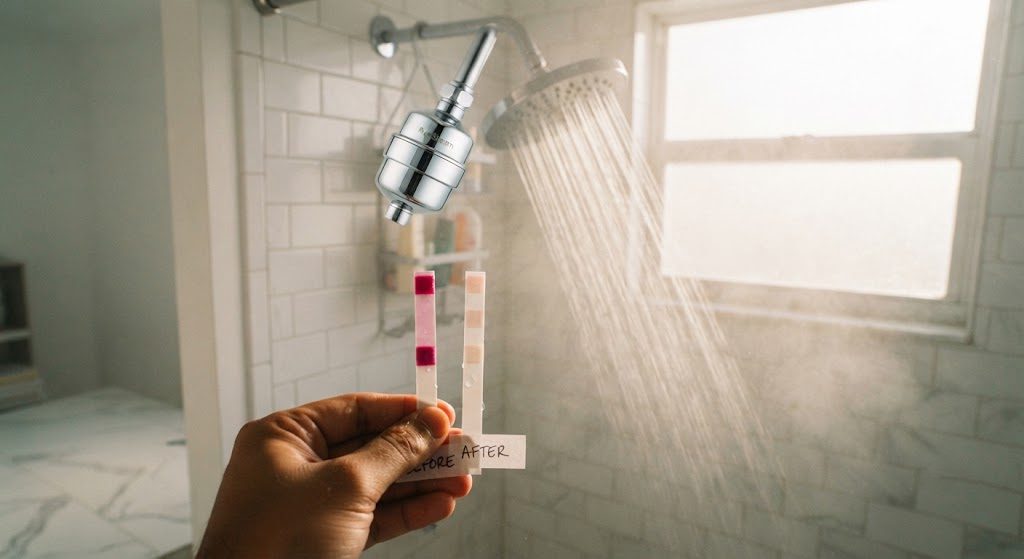
My test was simple: I filled a clean bucket with cold tap water — the same water that feeds the shower — and measured free chlorine with a test strip. Then I ran the shower for one minute to flush the filter, collected a second sample directly from the showerhead, and dipped a fresh strip. I repeated this for each filter, noting the color change and matching it to the strip's ppm scale. I also checked flow rate with a simple timer-and-bucket method to see if any filter choked the water pressure.
The Results
Miami tap water measured 1.8 ppm free chlorine — moderate, but definitely enough to smell. The $15 inline filter brought that down to 0.5 ppm. Not a perfect removal, but a 72% reduction that took the chlorine below the threshold where your nose complains. The $35 filtered showerhead did even better: undetectable chlorine on the strip, or less than 0.2 ppm. The KDF and carbon combo worked fast, and the water felt noticeably softer on my skin after a week of use. The $70 multi-stage unit also hit undetectable levels, with the added benefit of a sediment pre-filter that I could see turning beige after a few days — evidence of fine particles that would have ended up on my hair.
Flow rate took a hit only on the $70 unit. It dropped from 2.2 gallons per minute to 1.7 GPM — still acceptable, but noticeable. The $15 and $35 units didn't reduce pressure at all. I also checked TDS out of curiosity; none of the filters changed it. That's expected. Shower filters are not water softeners. They target chlorine and sometimes sediment, not dissolved minerals.
Which One Should You Buy?
If you're renting and want a zero-commitment fix, the $15 inline filter is genuinely effective and takes 60 seconds to install. If you own your place or care more about skin and hair health, the $35 filtered showerhead is the sweet spot — complete chlorine removal, better water contact time, and a built-in replaceable cartridge. The $70 unit is overkill for most people unless you're on well water or have sediment issues alongside chlorine. For Miami tap water, save the money and put it toward a new showerhead.
Your skin will notice the difference within a week. The test strips don't lie.