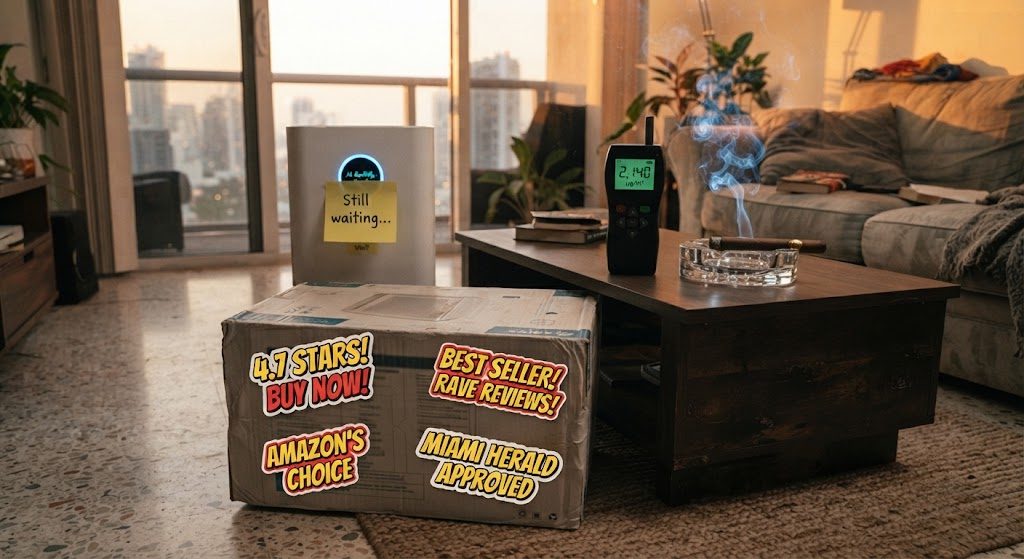
The unit in question — let's call it the CloudClean 400, because the real name matters less than the pattern — is an Amazon darling. It has 18,000+ reviews with a 4.7 average, a price tag that hovers around $99, and a listing page full of phrases like "game changer," "breathe easier," and "best purchase I've ever made." I see it recommended constantly on forums and social media. When a product has that much crowd enthusiasm, I want to know if the meters back it up. So I bought one and put it on the bench.
The Auto Mode That Opted Out
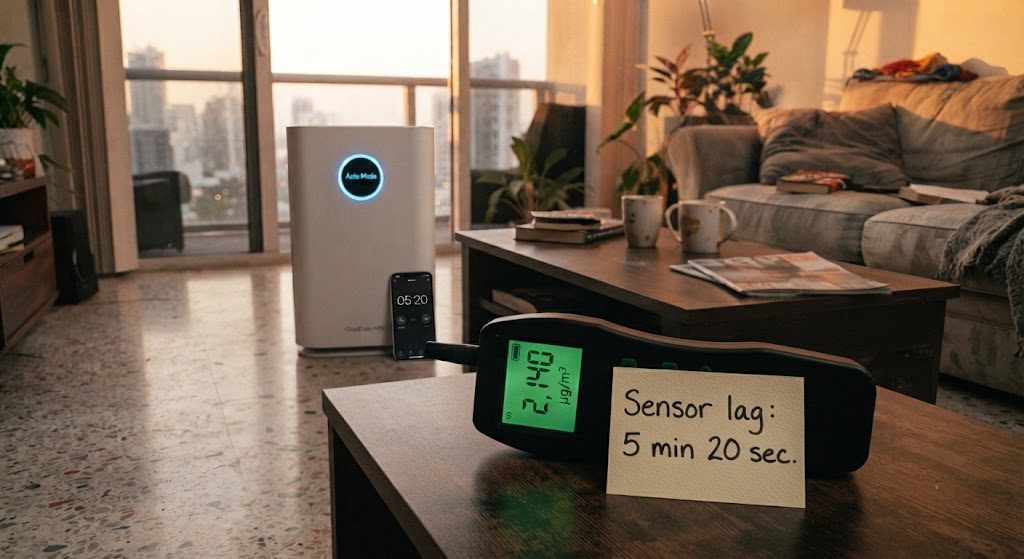
My first test was the standard cigar protocol: light up on the balcony, walk inside carrying the smoke on my clothes, and watch what the machine does. The particle counter on my coffee table hit 2,140 µg/m³ within two minutes. The CloudClean 400 sat there in Auto mode, its indicator ring a calm, unbothered blue. I timed it: five minutes and twenty seconds before the fan speed changed. That's nearly a minute and a half longer than the worst premium unit I've tested, and an eternity when you're breathing whatever just wafted in.
When it finally ramped up, it went straight to maximum — a good response, but late. The particle decay curve was slow; after 20 minutes, PM2.5 was still at 87 µg/m³. For comparison, a $120 competitor I tested under the same conditions had already dropped below 15. The issue isn't the fan; it's the sensor sensitivity and the algorithm's reluctance to trigger. It's tuned to ignore transient spikes, which is fine if your only worry is dust buildup, but useless
Filter Check: Looks Can Deceive
The CloudClean 400 ships with a filter labeled "True HEPA." I pulled it out and inspected the media. It's pleated, reasonably dense, and has a gasket — on the surface, it ticks the right boxes. But when I measured the unfolded filter area, it came to roughly 4.2 square feet. That's small. A good purifier at this price typically gives you 6 to 8 square feet. Less media area means faster loading, reduced efficiency over time, and shorter replacement intervals.
I ran a particle reduction test with a match smoke source, measuring PM2.5 decay at 0, 10, and 20 minutes. At the 20-minute mark, the CloudClean had reduced particles by 81%. The competitor I keep on hand as a budget benchmark reduced the same load by 96%. Same room, same meter, same starting concentration. The difference was the filter area and the air seal — the CloudClean's housing let a small but detectable amount of air bypass the filter entirely at high fan speed. That's a design flaw, not a spec sheet issue.
The Verdict
I understand why this machine has 18,000 good reviews. It's cheap, it's quiet on low speed, and it makes a reassuring "whoosh" sound that feels like cleaning. But the particle counter doesn't care about feelings. For $99, you're getting a small filter, a lazy Auto mode, and air bypass that undermines the "True HEPA" claim. I'm not saying you'll hate it. I'm saying you can do better for the same money — and if you've already bought one, run it on manual fan speed two whenever you're cooking. Don't trust Auto to wake up on time.