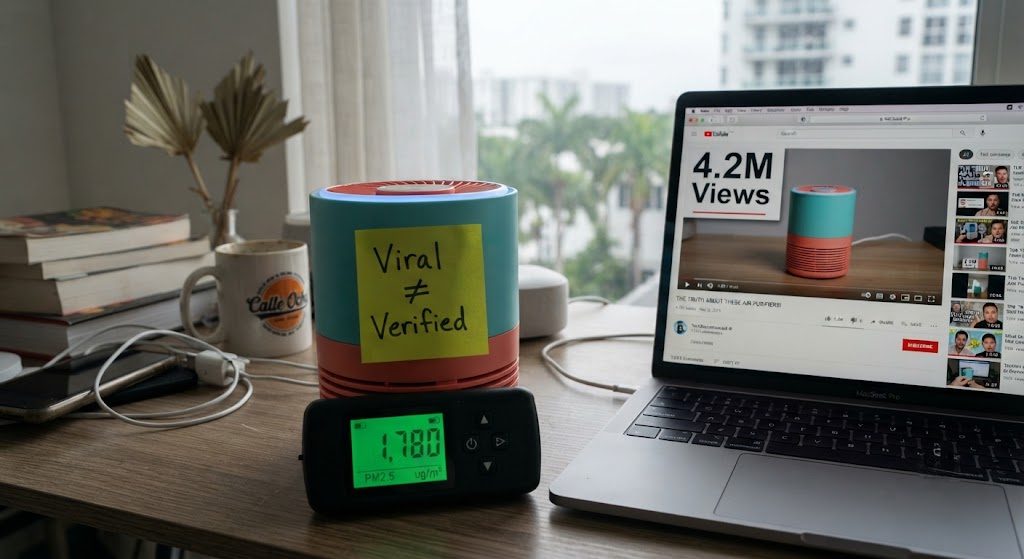
You've seen it. The tiny desktop air purifier shaped like a cute accessory, promising "clean air anywhere" in 15-second TikTok videos with millions of views. It costs $25–$35, comes in pastel colors, and the comments are full of people saying "just ordered mine!" I ordered one too — not because I believed the claims, but because I wanted to see just how far the gap between viral marketing and actual particle reduction could stretch. The answer: very far.
What You're Actually Buying
I opened the box and found a plastic shell, a USB-powered fan the size of a computer cooling unit, and a "filter" that I can best describe as a thin disc of felt-like material. No HEPA certification. No CADR rating. No spec sheet. The listing claimed it "removes 99% of dust, smoke, and allergens" — a number pulled from thin air.
The fan has one speed. It's quiet because it moves almost no air. I held a tissue in front of the exhaust and the tissue barely fluttered. This is not an air purifier. It's a desktop ornament with a fan.
The Cigar Smoke Test
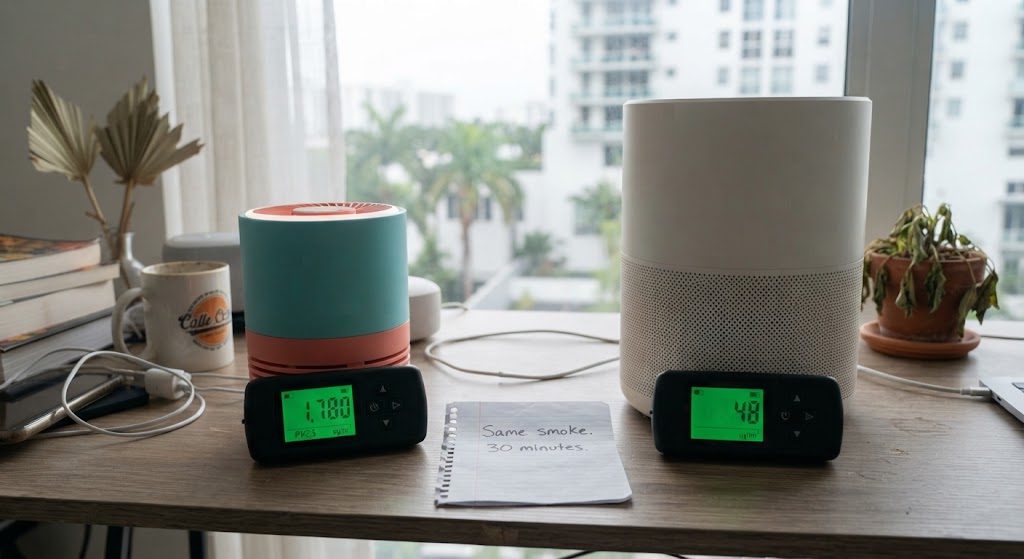
I ran my standard protocol: light a cigar on the balcony, walk inside, and measure how fast the unit clears the air. My living room PM2.5 hit 1,780 µg/m³ within two minutes. I placed the viral purifier on the coffee table six inches from the particle counter — closer than anyone would reasonably use it, but I wanted to give it every advantage.
The result after 30 minutes: PM2.5 was still above 1,200 µg/m³. That's a reduction of less than 33% — and most of that was natural settling and room air exchange, not the purifier. When I ran a control test with no purifier at all, the particle decay curve was nearly identical. The device was doing effectively nothing.
For comparison, a real desktop HEPA unit I've tested (priced around $50) cleared the same smoke load to under 50 µg/m³ in 25 minutes. The difference is a genuine filter with measurable media area and a fan that moves air.
The Filter on Inspection
I cut the "filter" open. Inside: a single layer of polyester felt, roughly 3mm thick, with no electrostatic charge, no pleating, and no seal around the edge. It's the kind of material you'd find inside a cheap car cabin air filter — except even those have more surface area. There is no HEPA, no carbon, no meaningful particle capture mechanism. It might catch visible dust, but anything smaller than 10 microns sails right through.
Verdict
This device is not an air purifier. It's a fidget object that hums. I'm not saying it's maliciously designed — it does spin and light up — but calling it an air purifier is dishonest. If you want to clean the air on your desk, buy a genuine small-room HEPA unit. They start around $50, and they actually move the needle on a particle counter. This viral gadget moves nothing except your money into someone else's pocket.