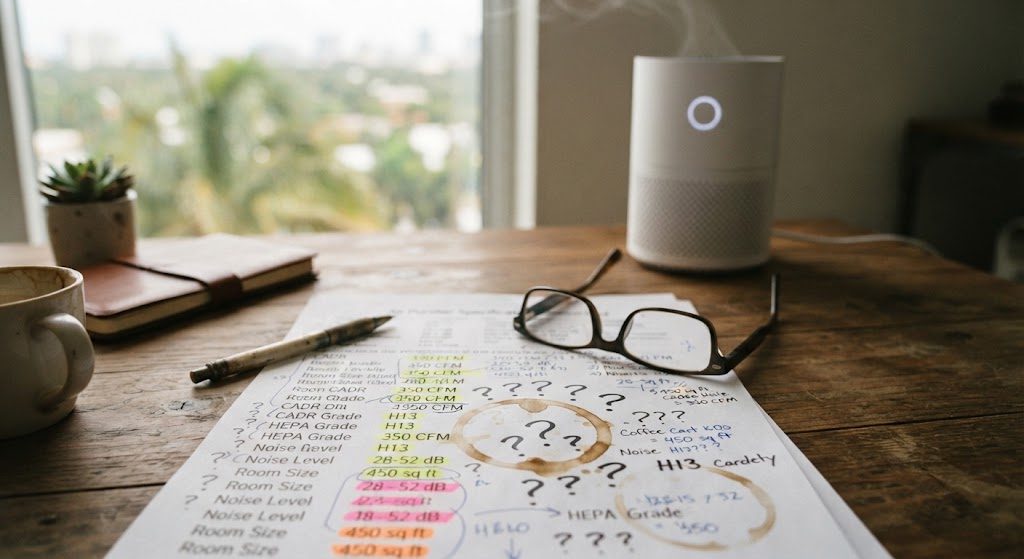
A spec sheet is a sales document disguised as a technical one. It buries the important numbers in a grid of impressive-sounding figures and hopes you'll skim. After testing over 150 air purifiers, I can tell you that six numbers actually predict real-world performance. The rest is noise. Here's how to read a spec sheet in under two minutes and walk away knowing whether the machine is worth your money.
CADR — The Only Number That Predicts Speed
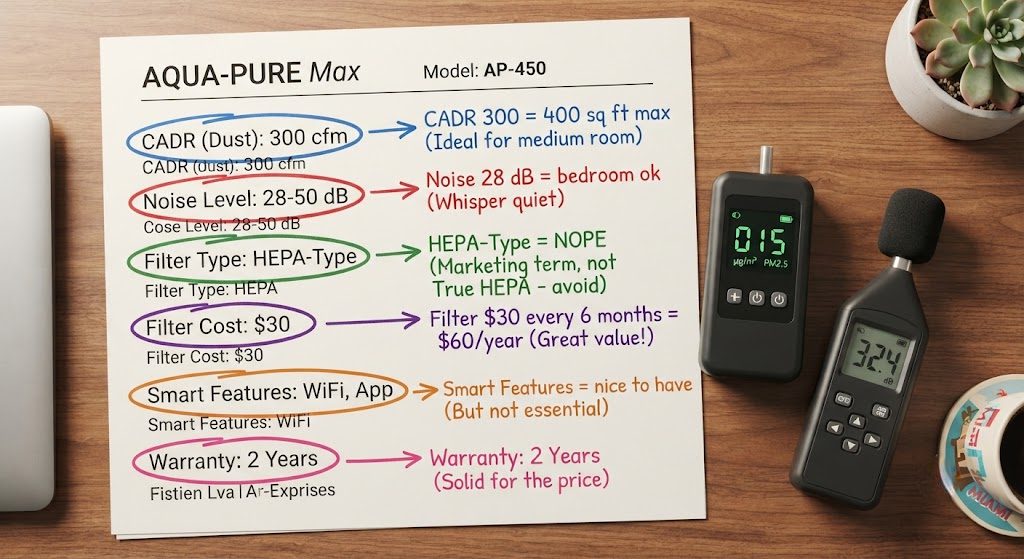
Clean Air Delivery Rate measures how many cubic feet of clean air the purifier delivers per minute, tested separately for smoke, dust, and pollen. Higher is better, but only up to a point. A Smoke CADR of 300 will handle a 400-square-foot room with the door closed. For open-plan spaces, multiply the Smoke CADR by 0.8 to get a realistic room size. If a manufacturer only lists Dust CADR, they're hiding a weak smoke score. Move on.
ACH — The Number That Connects to Your Room
Air Changes Per Hour tells you how many times the purifier can filter the entire room's air volume in 60 minutes. ACH is calculated from CADR and room size, so it's only as honest as the room size the manufacturer chose. Aim for 4 ACH at minimum — that means the air is filtered every 15 minutes. For allergies or asthma, 5 or 6 ACH is better. If the spec sheet doesn't list ACH at all, calculate it yourself: (CADR × 60) ÷ room volume in cubic feet.
Noise — The Number That Determines If You'll Actually Use It
Manufacturers love the word "whisper-quiet." Ignore adjectives and find the decibel rating at each fan speed. Low speed should be under 30 dB — genuinely quiet enough for a bedroom. Medium speed, where most units run in Auto mode, should sit between 35 and 45 dB. High speed will be louder; anything under 55 dB is acceptable for daytime use. If the spec sheet doesn't list decibels by speed, the manufacturer doesn't want you to know how loud it gets.
Filter Type and Replacement Cost — The Ongoing Investment
"True HEPA" or "H13 HEPA" is the minimum acceptable standard. "HEPA-Type" is meaningless. Beyond the label, check two things: the filter's unfolded media area and the replacement cost. More media area means longer filter life and less frequent replacements. Then do the annual math: a $30 filter replaced every 6 months costs $60 per year. Over five years, that's $300 in filters alone — possibly more than the purifier itself. The cheapest machine sometimes has the most expensive filters. Always check before buying.
Power Draw — The Number on Your Electric Bill
Most air purifiers draw between 5 and 50 watts on low, and 40 to 100 watts on high. A unit running 12 hours a day at 40 watts costs roughly $3–$5 per month in electricity at average U.S. rates. That's negligible for one unit, but if you're running multiple purifiers, the difference between a 5-watt and a 50-watt low-speed draw adds up. Check the wattage at the fan speed you'll actually use — not just the maximum.
Room Size — The Number You Should Ignore
The "recommended room size" on the box is almost always based on running the unit on high speed with a sealed room — conditions that don't exist in a real home. Use the Smoke CADR rule instead. A machine that claims 500 square feet with a Smoke CADR of 180 will disappoint you in any room larger than about 220 square feet.
A spec sheet isn't a lie, but it's a curated version of the truth. Focus on these six numbers and you'll never stare at a box in the aisle wondering what matters. You'll know.